
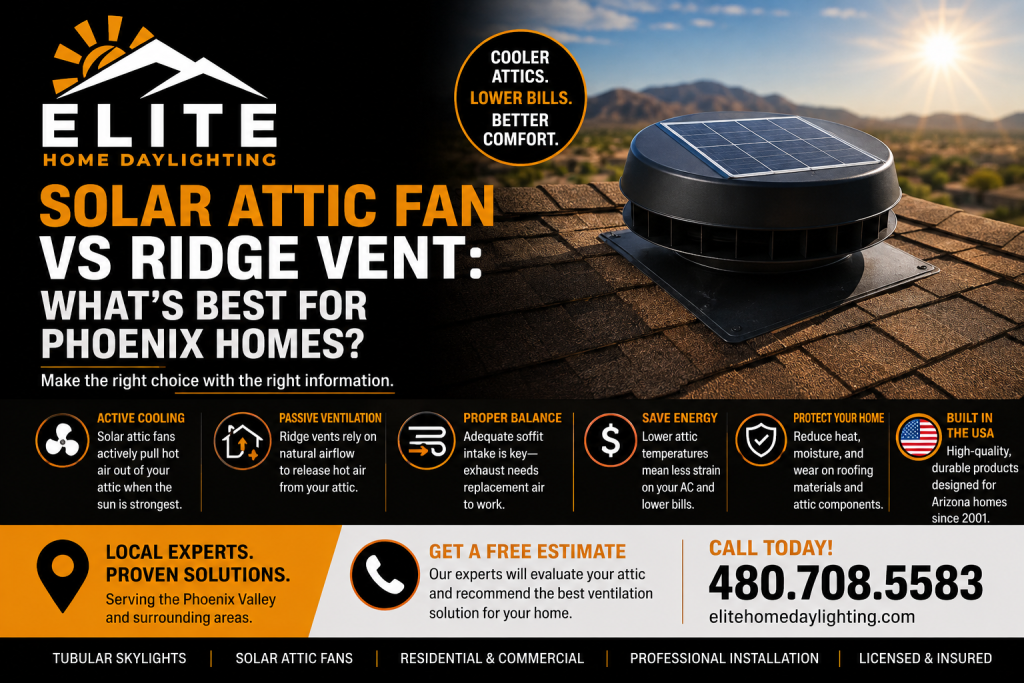
Solar Attic Fan Vs Ridge Vent: Which Is Better For A Phoenix Home?
A hot attic does not automatically mean the roof needs another vent. It means the entire ventilation path should be checked. Phoenix homeowners comparing a solar attic fan versus a ridge vent are considering two different ways of moving air, and either can disappoint when the intake side is weak.
The better choice depends on roof shape, attic layout, existing vents, insulation, air sealing, and the amount of clear soffit intake available.
They Move Air In Different Ways
A ridge vent is a passive exhaust opening along the highest part of a pitched roof. Warm attic air can escape while replacement air enters lower openings, usually at the soffits. The system has no motor and relies on natural air movement and wind pressure.
A solar attic fan is active exhaust. Its solar panel powers a fan that pulls air from the attic while sunlight is available. That makes it useful during bright Arizona afternoons, when roof surfaces receive their greatest solar load.
Neither system creates replacement air. Every cubic foot exhausted must enter through suitable intake vents.
Start With The Soffit Intake
Soffit vents may be too small, painted over, blocked by insulation, or missing from part of the house. Adding stronger exhaust without enough intake can produce poor airflow.
ENERGY STAR warns that an attic fan can pull conditioned air through ceiling leaks when soffit vents are blocked and the attic floor is not properly sealed. Before choosing another exhaust device, inspect the eaves and the boundary between the living space and attic.
Recessed lights, wiring penetrations, plumbing openings, attic hatches, and duct gaps can all affect how the system behaves.
Ridge Vents Suit Some Roofs Better
A ridge vent can work well on a straightforward gable roof with a long ridge, open attic space, and continuous soffit intake. It is less useful when the ridge is short or the attic is divided by additions, vaulted sections, or changes in roof height.
Many Phoenix homes have limited usable ridge length. Others contain several attic compartments that do not share air freely. In those cases, a passive opening at one high point may not address every hot section.
The condition of the existing ridge vent also matters. A covered slot or blocked intake can make the vent appear inadequate when the problem is elsewhere.
A Solar Fan Provides Targeted Exhaust
A roof mounted solar fan can be placed over a section that needs active airflow. The unit should be selected by attic area, airflow rating, roof configuration, and intake capacity rather than appearance.
Elite Home Daylighting installs 20 watt fans rated at 1,400 CFM for homes up to 2,000 square feet and 30 watt models rated at 1,700 CFM for homes up to 2,500 square feet. Those figures are a starting point. A large or divided attic may need more than one ventilation zone, while a smaller attic may not benefit from an oversized fan.
Do Not Combine Exhaust Vents Blindly
More exhaust is not always better. A powered fan installed too close to a ridge or static roof vent may draw outside air through that nearby exhaust opening instead of pulling replacement air from the soffits. Lower attic areas may then receive little useful circulation.
That does not mean a ridge vent and solar fan can never share a roof. Their location, capacity, and intake path need to be assessed together. Sometimes an existing passive system improves once blocked intake is corrected. In another home, targeted powered ventilation may be reasonable.
Check Insulation And Air Sealing
Attic ventilation cannot correct missing insulation, leaky ducts, or large openings between the attic and conditioned rooms. A useful inspection looks at roof geometry, vent placement, soffit area, insulation, air leakage, and separate attic sections before recommending equipment.
Get A Phoenix Attic Ventilation Recommendation
Elite Home Daylighting Systems installs solar powered attic fans throughout the Phoenix Valley. The company has provided daylighting and ventilation installations since 2001 and offers 10 watt, 20 watt, and 30 watt fan options. Call 480 708 5583 for a free estimate and a site specific recommendation based on your roof, attic, intake vents, and existing ventilation.
Live References
Elite Home Daylighting Systems: Solar Powered Fans
https://elitehomedaylighting.com/installation-services/solar-fans/
ENERGY STAR: About Attic Ventilation
https://www.energystar.gov/saveathome/seal_insulate/do-it-yourself-guide/about-attic-ventilation
GAF: Attic Ventilation Calculator
https://www.gaf.com/en-us/resources/ventilation-calculator
Building America Solution Center: Attic Ventilation Fans
https://basc.pnnl.gov/information/attic-ventilation-fans
National Roofing Contractors Association: Attic Ventilation
https://www.nrca.net/roofingguidelines/pdf?id=145172&k=2872704